Multi-Disc Rotary Generator (MDRG)
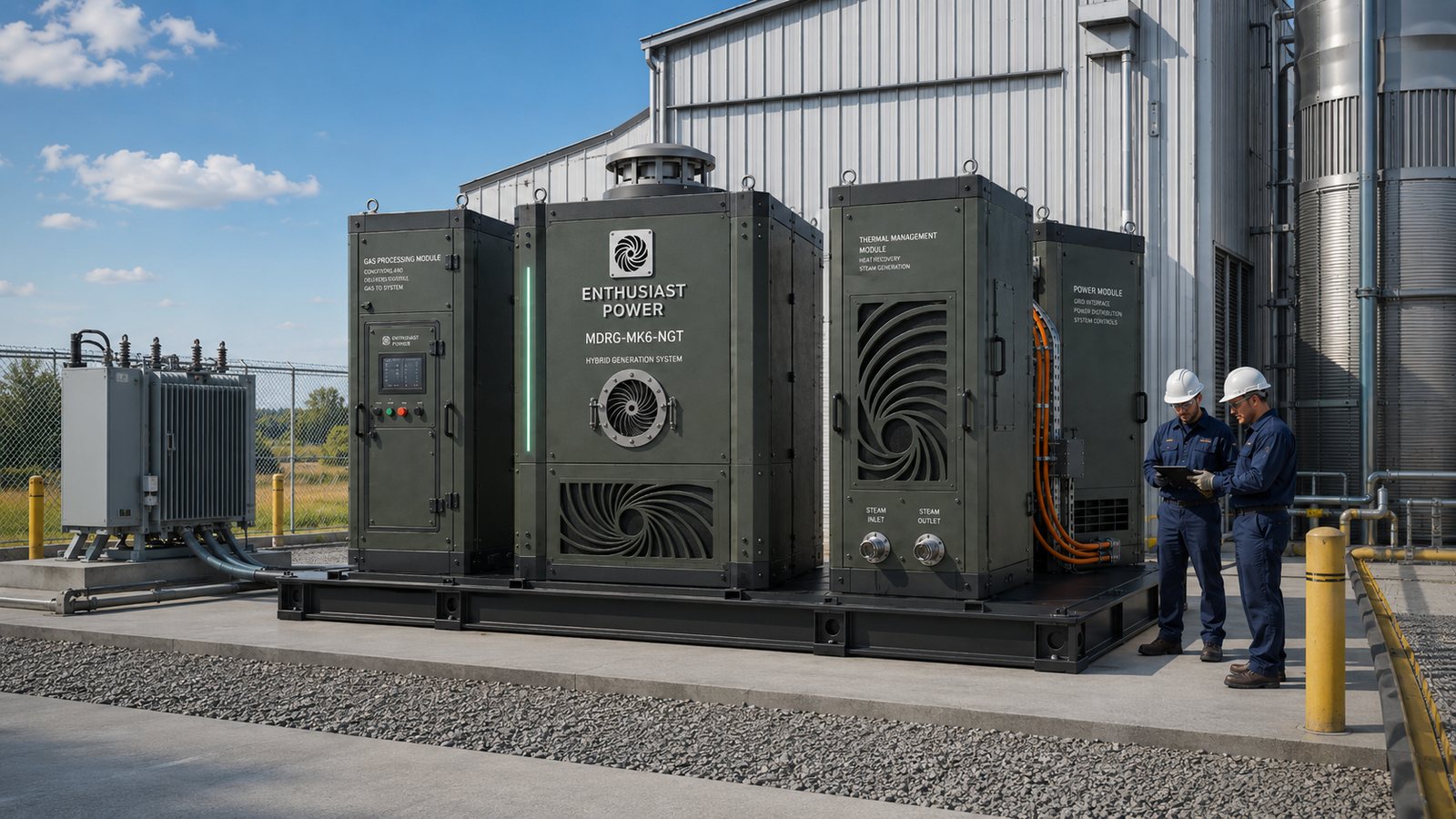
The MDRG-MK6-NGT is a turbocharged Brayton-cycle turbine generator. It burns raw wellhead methane continuously to spin a direct-drive permanent-magnet generator that puts out 75 kWe of 480 V three-phase power. An optional thermal module recovers heat to produce midgrade steam.
01
Fuel and Intake
Your gas enters at wellhead pressure, dewetted but otherwise untreated. Intake air is filtered through the front housing air cleaner insert.
02
Compression and Boost
A turbocharger compresses inlet air pressure ahead of the combustor to feed the combustion and system processes.
03
Continuous Combustion
Fuel and boosted air burn continuously in an annular combustor. The cycle absorbs variable gas composition and intermittent flow instead of stalling on them.
04
Expansion and Durability
Hot gas expands through our novel disc rotor assembly creating rotation and torque. Carry‑over moisture and particulate pass straight through.
05
Generation & Exhaust
A permanent-magnet generator runs on a common shaft. Output is conditioned to 480 V three-phase, and an optional thermal module recovers the exhaust heat for midgrade steam generation.
Stranded gas in. Power and revenue out.
We run behind your meter, or tie to the grid where the wire already exists.
DispatchableRuns on wellhead flow, around the clock
Either side of the meter480 V three-phase — behind-the-meter or grid-tied
HOW it earnsWe sell the power and heat or offset your own onsite loads.
| Cycle | Turbocharged Brayton | Continuous combustion even with variable composition |
| Nominal output | 75 kWe | CFD-validated · Early stage prototype tested |
| Generator | 95 kW PMG | High-speed direct drive permanent magnet |
| Electrical interconnect | 480 V, 3-phase | Behind-the-meter or grid-tied · Conditioned output via transmission grade inverter |
| Rotor process | IN718 · single-shot DMLS | The entire rotating assembly is a single laser sintered unit incorporating our novel geometries |
| Turbine housing | IN718 · modular design | Designed to be field repairable with a modular assembly design |
| Bearings | Silicon nitride hybrid | Oilless bearing system reduces complexity and cost · field serviced at yearly intervals. |
| Fuel | Dewetted wellhead gas | 70% CH₄ minimum · no pre-treatment skid required |
| Fuel drawn | 17 Mcf/day | Single unit optimal draw |
| Field install | 2 days | Skid-mounted · 2-person crew |
| Service interval | 8,760 hr / 1 year | Hot section out as a unit · 2-person crew, one day |
| Program status | First Fire 2027 | Proof of Concept Deployment |